
Zombie Types in Defend my Ring Farm
Zombie types in Defend my Ring Farm: regular, runner, brute, and Night variants. How each pressures the ring and how to counter them.
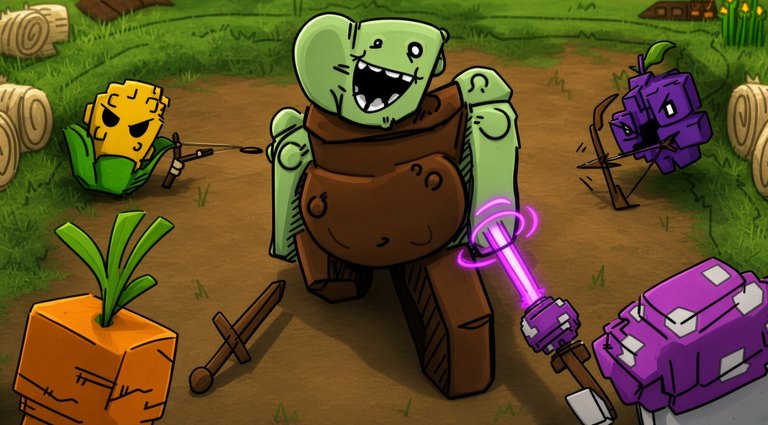
Zombies are the tax on every greedy expand in Defend my Ring Farm. They walk the ring path from the graveside, press plant lanes, and punish empty tiles. This page names what Memories Game has shown in official art and gameplay, maps each type to a pressure role, and gives the counter recipe that holds from wave one to wave fifty.
What official art tells us
The gallery screenshots show at least three distinct zombie silhouettes pressing the ring:
- Regular zombies — blocky green figures that walk the path in groups. They are the baseline pressure.
- Runners — leaner, faster silhouettes that dart ahead of the pack and pressure gaps before melee can react.
- Brutes — larger, heavier zombie forms that take more hits before going down.
The Night event adds undead-themed reskins (purple sword zombie, downed purple brute visible in the farmyard shot), but the pressure role stays the same: speed, health, or numbers.
How waves actually move
Waves do not scatter randomly. They press the ring path from the grave side of the map. The geometry of the ring means zombies naturally stack at:
- Contact tiles — where the path meets a plant.
- Pinch points — tight curves where two lanes meet.
- Fresh expand edges — newly added tiles that have no plant yet.
That stack point is where a shield tuber earns its slot, and where a laser beet earns its S rank.
Regular zombies
Green, blocky, medium speed. They form the body of every early wave and the filler in late waves. Plant a melee on the contact tile and a ranged unit one tile back, and regular zombies die in sequence. The problem is not them individually — it is that the wave keeps coming, and an empty tile on the path means they walk through to the inner ring.
Counter: coverage. Melee on contact, ranged behind. Fill expansion tiles with commons so there is no hole in the line.
Runners
Faster silhouettes that dart ahead of the regular pack. They are the reason opening Shop mid-wave is lethal — a runner can cross the gap while the player is scrolling the code field. They also pressure the gaps in a coverage line: if there is a lane with no plant, runners find it before melee can rotate.
Counter: ranged units (corn, grapes) positioned one tile behind melee so a runner cannot slip past the front line without taking fire. A shield tuber on the pinch also slows runners so ranged has time to shoot.
Brutes
Heavier zombie forms that take more hits. In the farmyard screenshot a brute is shown going down under the combined fire of carrot, corn, and grapes — but not quickly. A lone melee is not enough. Brutes are the reason the plant army needs A-tier ranged support, not just a wall of sword carrots.
Counter: ranged units stacking damage on the same target. A grape behind a carrot means two sources firing at once. The laser beet, when owned, faces brutes at the clump point for a fast delete.
Purple sword zombie (Night variant)
Night screenshots show a purple-armored zombie with a sword in the mix. This is a reskin of a regular or brute type with thematic Night lighting — it is not a fourth class. The counter playbook is identical to its non-purple counterpart: melee on contact, ranged behind, tank on the pinch.
Do not assume the Night variant has different HP or speed until official stats are published. The purple sword zombie appears in the same action shot as the regular green pack.
Wave stacking behaviour
Zombies do not attack simultaneously from all directions. They queue along the ring path, which means the first wave is manageable and the stack grows as the wave progresses. That is why a hold that works on wave one also works on wave fifty: the positions do not change, only the number of bodies at each position.
The practical habit:
- Watch where the first zombie steps onto the ring path.
- Plant your melee on that tile.
- Back it with ranged.
- Watch the stack grow at the pinch — that is where the shield goes.
- Fill every empty tile before starting the wave.
What changes per wave
Not the type mix — the density. Early waves are regular zombies with a runner. Mid waves add brutes. Late waves are the same positions with more stacked bodies. The counter stays the same; you just need more of it on the busiest lane.
Night does not add new zombie classes. It adds visibility pressure and undead reskins. The ring holds the same way in the dark: every tile covered, melee on contact, ranged back, tank on pinch.
Related pages
Wave survival mechanics: Wave Survival. Defense habits: How to Defend. Plant roles against the stack: Plant Tier List. Night pressure: Night Event.
Frequently Asked Questions
Quick answers for codes, waves, and plant rolls.
How many zombie types are there?
At least three visible in official art: regular, runner, and brute. Night adds purple reskins but the same roles.
What is the difference between runners and brutes?
Runners are fast and pressure gaps before melee can react. Brutes are slow and tanky but die to stacked ranged damage.
Do zombies get harder or just more numerous?
Mainly more numerous. The same positions stack with more bodies; the counter playbook stays the same.
Does Night add new zombie types?
No new classes — only undead reskins (purple variants) with the same pressure roles as the base types.